
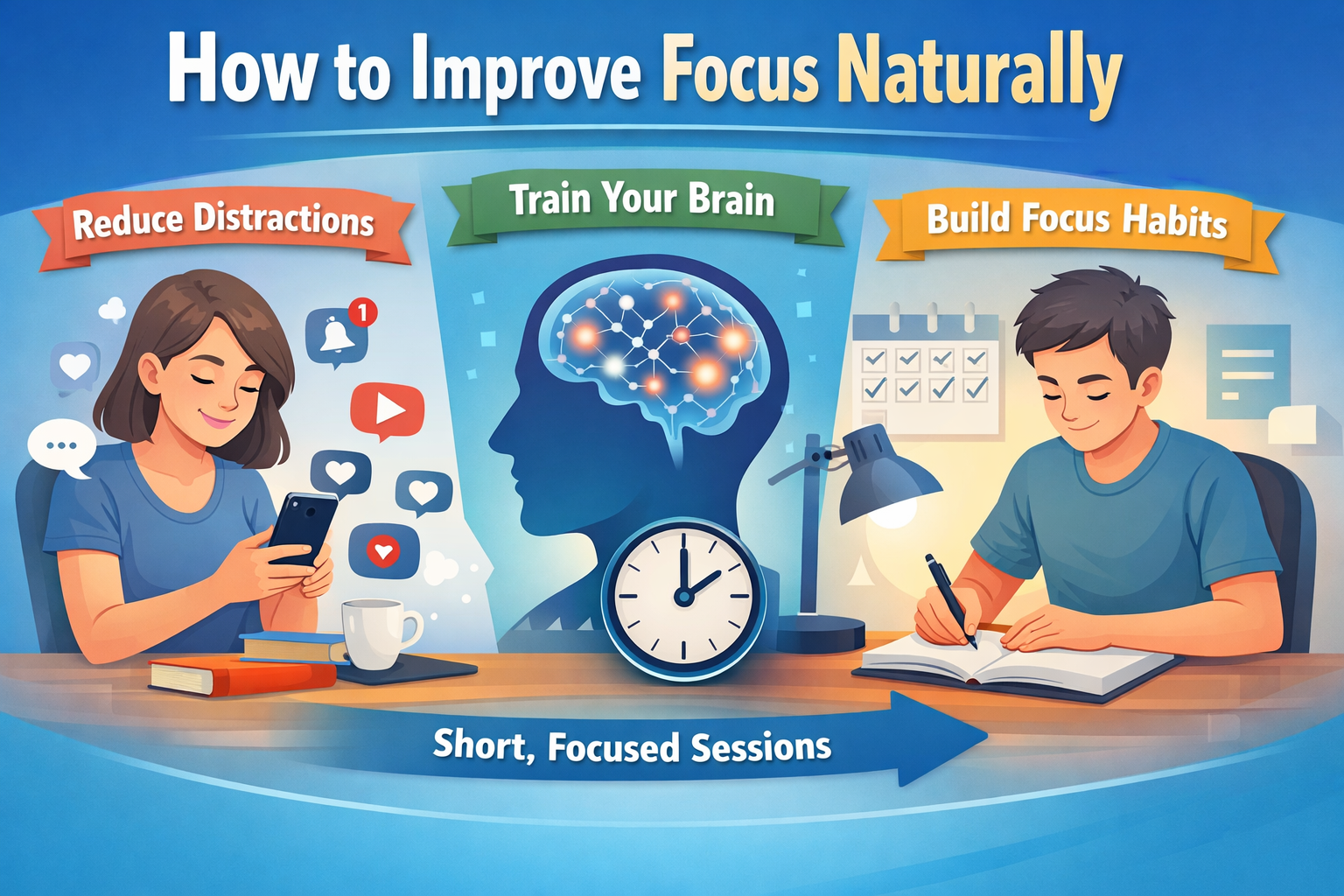
How to Improve Focus Naturally: A Psychology-Based Guide
Staying focused has become harder than ever. Many people believe their lack of focus is caused by laziness, low motivation, or weak discipline. Psychology tells a very different story.
Focus is not a talent you are born with. It is a mental skill shaped by your brain, habits, and environment. Once you understand how attention really works, improving focus becomes a practical process instead of a constant struggle.
This guide by theyouthvibe explains how focus works, why it breaks down, and how you can rebuild it naturally without forcing productivity or burning yourself out.
What Focus Really Is (And What It Is Not)
Focus is your brain’s ability to direct attention toward one task while ignoring distractions. It is controlled by the prefrontal cortex, the part of the brain responsible for planning, decision-making, and self-control.
Focus is not:
- Constant motivation
- Long hours of effort
- Multitasking
True focus is selective attention, not mental pressure.
When your brain is overloaded, overstimulated, or mentally tired, focus naturally weakens. This is not failure. It is feedback.
Why Focus Is So Difficult Today
Modern life works against deep focus. Your brain is surrounded by constant stimulation, fast rewards, and endless choices. Each notification, message, or tab competes for your attention.
Psychology shows that the brain prioritizes:
- Immediate rewards
- Familiar patterns
- Low-effort tasks
Deep focus feels slow and uncertain, so the brain resists it.
This resistance is explained in detail in the psychology behind focus and deep work, where mental effort feels uncomfortable even when the task is important.
Master Your Mind: The Practical Guide to Developing a Growth Mindset
How Dopamine Shapes Your Attention
Dopamine plays a major role in focus. It pushes your brain toward activities that promise quick rewards. Scrolling, notifications, and short videos all provide instant dopamine with little effort.
Deep focus works differently. The reward comes after effort, not before.
When your brain becomes used to fast dopamine spikes, sustained attention feels boring and difficult. This is why reducing constant stimulation is essential for rebuilding focus.
Dopamine and Focus: Why Instant Gratification Kills Attention
For more understanding, read the book called The Focused Leader: Mastering the Art of Clarity and Purpose in Leadership
The Cost of Multitasking on Focus
Multitasking is one of the biggest focus killers. Psychology research shows that what feels like multitasking is actually rapid task switching.
Each switch forces your brain to reset attention, draining mental energy and reducing clarity. Over time, this trains the brain to expect constant novelty, making deep work feel uncomfortable.
Single-tasking may feel slower at first, but it produces stronger focus and better results.
Why Multitasking Is Destroying Your Attention Span
To understand how your brain shifts between distraction and deep focus, neuroscientists explain the concept of flow — a state of intense, sustained attention — and how brain chemistry supports it. You can read more about the science behind deep focus on BrainFacts.org (an authoritative neuroscience resource).
Mental Fatigue and Focus Loss
Focus does not disappear because you are weak. It disappears because your brain is tired.
Mental fatigue happens when:
- You make too many decisions
- You stay mentally “on” all day
- You never fully rest your attention
When this happens, your brain shifts into energy-saving mode. Focus drops, motivation fades, and simple tasks feel heavy.
Learning to manage mental energy is as important as learning focus techniques.
Mental Fatigue Explained: Why Your Brain Feels Tired
How Focus Improves Over Time
Focus improves through gradual exposure, not force. When you stay with a task slightly longer than feels comfortable, your brain adapts.
Neural pathways linked to attention strengthen. Resistance decreases. Focus becomes easier.
This is why consistency matters more than intensity. Ten minutes of daily focus is more powerful than one forced hour.
Practical Ways to Improve Focus Naturally
Start by simplifying your environment. Remove obvious distractions before they compete for your attention. Focus improves faster when the brain has fewer choices.
Work in short, clear sessions. Your brain feels safer when it knows the task has an end. Over time, these sessions naturally grow longer.
Focus on one task at a time. When your brain knows exactly what to work on, resistance decreases.
Do not wait to feel motivated. Action creates motivation, not the other way around. This principle is explained clearly when comparing discipline and motivation.
Discipline vs Motivation: Which One Builds Focus Long-Term
Focus Habits That Actually Work
Focus is built through habits, not willpower. Simple daily behaviors train your brain to stay with one task longer.
Habits like starting work at the same time, using a focus ritual, and stopping before exhaustion help your brain associate focus with safety and progress.
Over time, these habits create mental stability instead of stress.
Focus Habits Backed by Psychology That Actually Work
Focus for Students and Beginners
Students often believe they need longer study hours to improve focus. Psychology shows the opposite.
Short, distraction-free study sessions produce better memory, clarity, and confidence. Focus grows when study feels manageable, not overwhelming.
How to Focus Better as a Student (Without Studying Longer)
Final Thoughts: Focus Is a Skill, Not a Struggle
Your brain is not broken. It is simply responding to the environment and habits you have trained it with.
When you reduce overstimulation, manage mental energy, and practice consistent attention, focus improves naturally.
Deep focus is not about forcing productivity. It is about creating conditions where your brain feels safe enough to stay.
Mastering focus improves more than work. It improves confidence, clarity, and long-term personal growth.
FAQ SECTION
Frequently Asked Questions
What is focus and why is it important?
Focus is your brain’s ability to direct attention toward one task while ignoring distractions. It is essential for productivity, learning, and achieving long-term goals. Strong focus allows you to work efficiently and think clearly.
Why is it hard to focus today?
Modern life is full of constant stimulation, notifications, and instant rewards. Your brain is wired to seek quick dopamine-driven rewards, which makes deep focus feel slow and uncomfortable.
Can focus be improved naturally?
Yes. Focus is a trainable skill. By practicing short, distraction-free sessions, building consistent habits, and managing mental energy, you can improve focus naturally without relying on willpower alone.
How long does it take to improve focus?
Most people notice improvements in attention and clarity within 2–3 weeks of consistent practice. Focus develops gradually as neural pathways linked to sustained attention strengthen over time.
What role does dopamine play in focus?
Dopamine influences motivation and attention. Frequent exposure to instant rewards, such as social media or short videos, trains the brain to avoid long attention spans. Reducing overstimulation and creating reward systems linked to progress can improve focus.
Are there habits that help focus?
Yes. Effective habits include:
- Short, focused work sessions
- Single-tasking instead of multitasking
- Using starting rituals to cue attention
- Taking regular breaks to prevent mental fatigue
How can students improve focus while studying?
Students can improve focus by studying in short, distraction-free sessions, focusing on one task at a time, and avoiding long hours without breaks. Quality of focus matters more than quantity of time spent.
Can focus and productivity be improved without eliminating all distractions?
Absolutely. The goal is not to eliminate all distractions but to train your brain to prioritize attention. Reducing high-dopamine triggers, creating structured focus sessions, and building consistent routines are enough to improve focus naturally.